
Blog
Digital Marketing Case Study: 7 Proven Strategies That Help Small Businesses Achieve Sustainable Growth

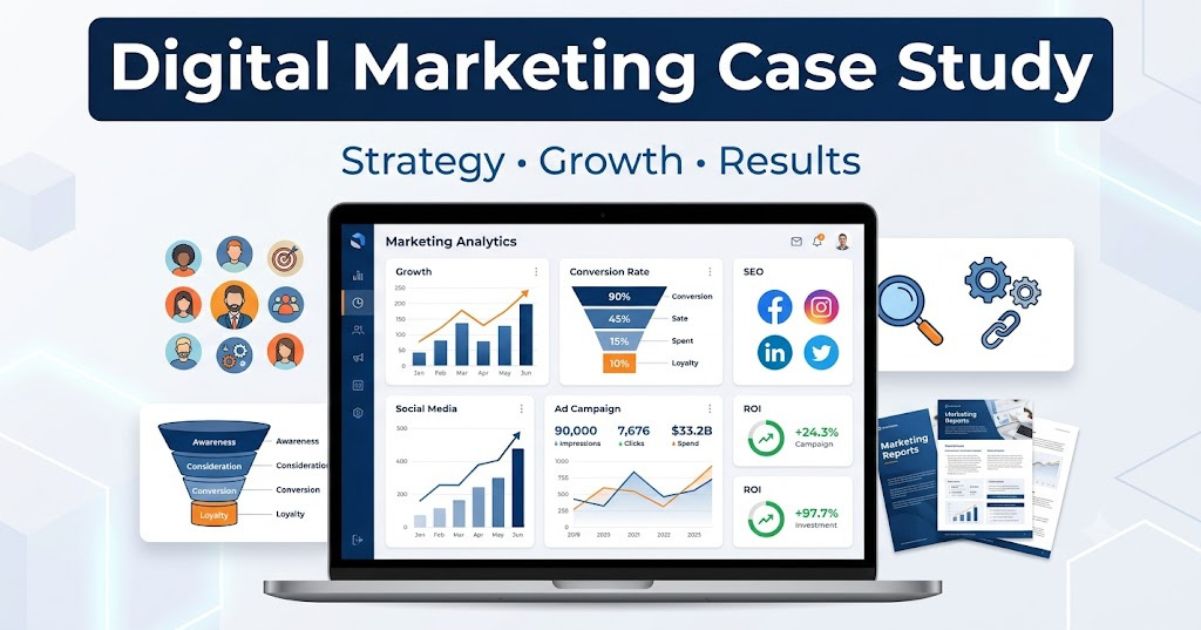
Digital Marketing Case Study: How Grobit Created a Sustainable Growth Strategy for Small Businesses
In today’s digital world, having an online presence is no longer enough. Customers search, compare, read reviews, and evaluate businesses before making a decision. That means visibility alone does not create growth — trust does.
At Grobit, we have observed a common pattern among small business owners. Many invest in websites, advertising, and social media but still struggle to generate consistent business results. Some attract traffic but fail to convert visitors. Others rely heavily on paid campaigns without creating long-term growth.
This digital marketing case study explains how a structured digital strategy can help businesses strengthen their online presence, improve customer trust, and create sustainable business growth.
Background: Understanding the Growth Challenge
The business already had an online presence. A website was active, marketing activities were running, and efforts were being made to attract customers.
However, despite these activities, growth remained inconsistent.
The business had four clear objectives:
Improve online visibility
Generate more qualified leads
Build stronger customer trust
Create sustainable business growth
At first glance, everything seemed to be in place. But a deeper analysis revealed that the issue was not the amount of marketing effort — it was the lack of strategic alignment.
The Challenge: When Marketing Activities Do Not Deliver Results
After conducting an initial audit, several important challenges became clear.
Website traffic existed, but conversions remained low. Visitors were not taking the desired actions because the messaging lacked clarity and the overall customer journey was not optimized.
Organic search visibility was also limited, increasing dependence on paid marketing channels.
Additionally, the business’s digital efforts were fragmented. Website performance, content creation, and marketing campaigns were operating independently instead of supporting a unified growth strategy.
As a result, visibility increased but business outcomes did not improve at the same pace.
The Strategy: Building Growth Through a Structured Approach
At Grobit, execution begins with understanding.
The first step involved conducting a complete digital audit. This included evaluating website performance, customer behavior, search opportunities, and content effectiveness.
One important insight emerged during the analysis:
The business did not need more traffic — it needed a better customer journey and stronger conversion opportunities.
Based on this insight, a structured growth framework was created.
Phase 1: Website Optimization to Improve Trust and Conversion
A website often creates the first impression of a business.
Instead of redesigning everything, focused improvements were implemented to improve clarity and user experience.
Messaging was refined so visitors could quickly understand:
What the business offers
Who it serves
What action to take next
The website structure was simplified, important sections were reorganized, and the mobile experience was improved. The objective was straightforward: reduce friction and create trust. These changes helped transform the website from an information source into a stronger business asset.
Phase 2: SEO and Content Strategy for Long-Term Growth
For sustainable growth, SEO became a key focus area.
The content strategy was built around customer intent rather than simply targeting keywords.
Content was designed to:
Answer customer questions
Educate visitors
Build credibility
Support decision-making
Technical improvements also helped strengthen search performance through better structure, internal linking, and content organization. This digital marketing case study demonstrates that SEO works best when valuable content and user experience support each other.
Phase 3: Aligning Performance Marketing with Business Goals
Paid marketing was treated as a growth accelerator rather than the foundation of growth.
Campaign targeting was refined and landing page experiences were aligned with business objectives.
Tracking systems were improved to ensure decisions were based on measurable performance rather than assumptions.
This approach created a more efficient marketing system and improved the overall customer acquisition process.
Results: What Changed After Implementation
Following strategic improvements, meaningful changes began to appear.
Website engagement improved and users became more likely to take relevant actions.
Lead quality increased and customer interactions became more valuable.
Most importantly, the business developed a stronger digital foundation that supported sustainable growth instead of short-term spikes.
The outcome reinforced one key idea:
Growth becomes more predictable when strategy and execution work together.
Key Lessons for Small Business Owners
This digital marketing case study highlights several important lessons.
First, traffic alone does not create business growth.
Second, websites should be treated as conversion assets rather than online brochures.
Third, SEO is not a short-term tactic — it is a long-term investment.
Fourth, customer trust directly influences conversion decisions.
Fifth, marketing channels perform better when they work together instead of independently.
Finally, consistency and continuous optimization often outperform short-term tactics.
Frequently Asked Questions (FAQs)
What is a digital marketing case study?
A digital marketing case study explains how marketing strategies are applied to solve business challenges and improve outcomes such as visibility, leads, and growth.
Why are case studies valuable for small businesses?
Case studies provide practical insights and help business owners understand how strategies work in real-world situations.
How long does digital marketing take to show results?
Results vary depending on goals and channels. Paid campaigns may deliver faster outcomes, while SEO and content marketing typically require consistent execution over time.
Is SEO important for small businesses?
Yes. SEO helps businesses improve organic visibility and reduce dependency on paid acquisition over time.
Can website optimization increase lead generation?
A better website experience can improve trust, engagement, and conversion opportunities.
Conclusion
This digital marketing case study demonstrates that sustainable business growth is not created through isolated marketing activities.
When website experience, SEO, content, and customer engagement work together under a clear strategy, businesses create stronger and more measurable outcomes.
At Grobit, the goal is not simply to improve visibility but to help businesses build trust and create long-term digital growth.
If your business is investing in digital marketing but not seeing consistent results, a strategy-led approach may be the next step toward sustainable success.
Ready to grow smarter? Connect with Grobit and build a stronger digital foundation for your business.
Follow for more updates on our social platforms:
Stay connected with us on:
Don’t miss out on the latest updates, insights, and content!